The Gut Side Of GLP-1s Nobody Talks About
GLP-1s may be helping your weight while stressing your gut.
Everybody is talking about GLP-1s.
Ozempic.
Wegovy.
Mounjaro.
Zepbound.
The weight loss.
The appetite suppression.
The blood sugar control.
And for many people, these drugs are changing lives.
But inside GI clinics, another conversation is quietly growing.
People are losing weight while simultaneously becoming:
- bloated
- constipated
- refluxy
- distended
- uncomfortable after meals
And the missing piece may not just be the drug itself.
It may be what the drug is doing to the gut.
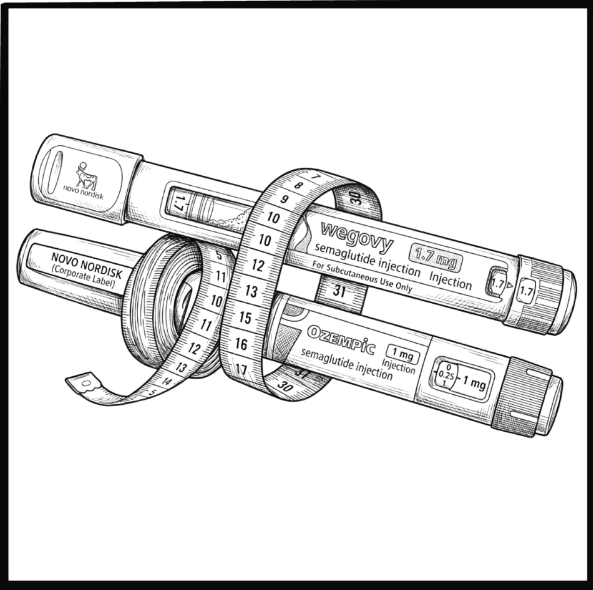
- GLP-1s may be helping your weight while stressing your gut.
- Bloating and constipation on GLP-1s are becoming increasingly common.
- Slower digestion can create the perfect environment for gut imbalance.
- Your microbiome may affect how well GLP-1s work for you.
- Weight loss and gut health should never be separated.
GLP-1s Slow The Gut Down
Most people know GLP-1 medications slow stomach emptying.
That’s part of why they work.
But digestion is not just about the stomach.
Your small intestine depends on movement too.
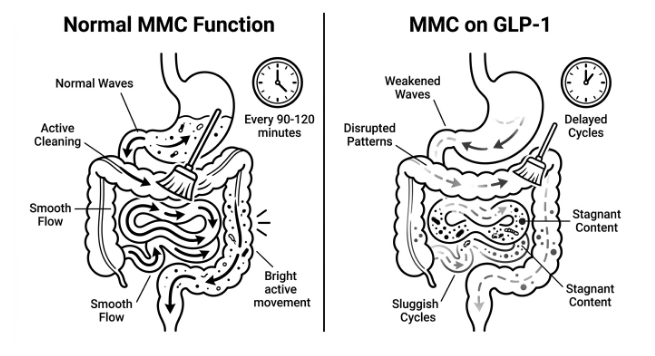
Between meals, the body activates something called the Migrating Motor Complex (MMC), essentially the gut’s cleaning cycle. It helps move bacteria, food particles, and debris downstream into the colon where they belong.
When movement slows too much, things sit longer than they should.
And when things sit, microbes have more opportunity to build up.
That’s where the SIBO conversation begins.
The Methane Problem
A recent study published in Foregut found significantly increased rates of small intestinal bacterial overgrowth (SIBO) and intestinal methanogen overgrowth (IMO) in patients using GLP-1 receptor agonists.1
One finding stood out:
Many of the positive breath tests were methane dominant.
Why does methane matter?
Because methane can actually slow the gut down even further.
Meaning the cycle becomes:
- slower motility
- more microbial buildup
- more methane
- even slower motility
For some people, this may explain why symptoms worsen the longer they stay on these medications.
Your Microbiome May Influence GLP-1 Success
Here’s where the conversation gets really interesting.
Your microbiome may not just react to GLP-1 medications.
It may influence how well they work in the first place.
Certain gut bacteria produce short-chain fatty acids (SCFAs), including butyrate, acetate, and propionate, which help stimulate the body’s natural GLP-1 release.2
Emerging research now suggests that gut microbial composition may partially influence GLP-1 responsiveness and treatment outcomes.2
In other words:
The microbiome may be part of the metabolic conversation itself.

So What’s The Solution?
This doesn’t mean GLP-1 medications are bad.
For many people, they are incredibly effective tools.
But if someone develops:
- bloating
- constipation
- reflux
- excessive fullness
- pressure after meals
- feels like the medication “stopped working”
The gut may need support, too.
According to Dr. Ken Brown, the missing piece for some patients may be gut motility and microbial balance.
If methane-producing microbes are accumulating and further slowing the gut, simply increasing the GLP-1 dose may not address the underlying issue.
This is where supporting the gut ecosystem may become important.
Tools like Atrantil may eventually fit into that conversation by:
- helping support microbial balance
- helping support motility
- helping support the gut environment while using GLP-1 medications
Because metabolism and the microbiome are deeply connected.
Listen To The Full Episode
In his latest Gut Check Project podcast, Dr. Ken Brown dives deeper into:
- GLP-1 medications and gut motility
- methane and constipation
- SIBO and microbial overgrowth
- the microbiome’s role in metabolism
- why digestive symptoms on GLP-1s shouldn’t simply be ignored
Listen to the full episode:
And that’s all regarding your gut, till next time!
The Re: Gut Team
References
- Damianos JA, Fredrick TW, Jin MF, Ospina-Velasquez L, Wang XJ, et al. GLP-1 receptor agonist use is associated with small intestinal bacterial overgrowth and intestinal methanogen overgrowth. Foregut. 2025. doi:10.1177/26345161251353437.
- Kamath S, Chan NSL, Joyce P. GLP-1 agonists and the gut microbiome: A bidirectional relationship. Br J Clin Pharmacol. 2026;92:1309-1325. doi:10.1002/bcp.70487.